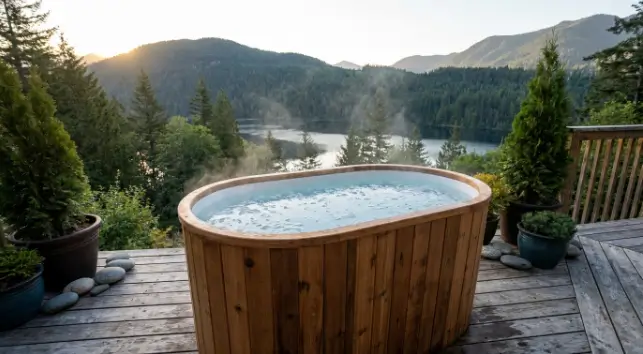
A compact cold plunge rarely moves a home’s appraised value in a direct, measurable way, but it can shorten time on market and widen buyer interest in a tight lot where a freestanding, portable amenity reads as a clear usable feature rather than a permanent commitment. Because a two-person tub is portable, it carries less resale risk than a built-in or sunken installation, which the next owner either has to want or has to remove. The more reliable return isn’t at sale at all, it’s the years of daily use an owner gets from a setup that fits comfortably in a small yard, garage bay, or covered patio.
Does Real Estate Data Show a Direct Value Bump?
Appraisers weigh comparable recent sales far more heavily than individual amenities, and a freestanding cold plunge tub, unlike a finished basement or an added bathroom, doesn’t have an established line item in most appraisal models the way square footage or bedroom count does. What shows up instead, according to agents who track buyer feedback in listings with wellness amenities, is faster interest and more showings rather than a specific dollar increase attributable to the tub itself. For a small property where every square foot of outdoor space matters, a compact amenity that photographs well and demonstrates a clear, established use case can help a listing stand out, even if it doesn’t move the number an appraiser writes down.
Why Is a Compact, Portable Tub a Safer Bet Than a Built-In Feature?
A sunken or built-in cold plunge is a fixed feature the next owner either wants or has to deal with removing, which is a real cost and disruption if they don’t. A freestanding two-person tub sidesteps that risk entirely, since it can move with the seller to a new home, get sold separately, or simply stay as a bonus if the buyer wants it, without the property being built around it structurally. This matters more in a small-space install specifically, since a compact tub tucked into a garage bay or corner patio doesn’t require the same excavation, plumbing, or structural commitment a built-in plunge pool would, keeping the whole investment lower-risk from the start.
What Do Buyers Actually Notice in a Small Yard or Patio?
In a larger property with a pool, an outdoor kitchen, and a big patio, one more amenity can get lost in the mix. In a small yard, a well-placed cold plunge tends to stand out precisely because there’s less competing for attention, and it demonstrates that the space was used thoughtfully rather than left as unused lawn. Buyers touring a compact home often respond to signs that a limited footprint was maximized, and a tidy, purpose-built corner with a plunge tub, proper drainage, and a dedicated electrical circuit reads as intentional rather than crowded, which is a meaningfully different impression than a cluttered small yard leaves.
Does the Health Evidence Support Marketing It as a Wellness Feature?
The evidence is genuinely mixed, and an honest answer matters more than an enthusiastic one. A 2025 systematic review and meta-analysis in PLoS One looked at cold water immersion’s effects on health and wellbeing broadly and found real but limited support for the strongest claims often made about it. Separate research on cold water immersion after exercise has found it associated with improved perceived recovery in some studies, and a Cochrane review found modest reductions in muscle soreness, though evidence quality varied across the included trials. Notably, cold water immersion done right after resistance training may blunt strength and muscle-building adaptations in some research, meaning frequent use isn’t automatically better for anyone training seriously. None of this means a cold plunge lacks value, but it does mean framing it as a proven medical intervention oversells the science, while framing it as a genuinely useful recovery and wellness habit is fair.
What’s the Real Return: Resale Value or Daily-Use Value?
For most owners, the better way to think about return is years of regular use, not a hypothetical appraisal bump. A compact tub used three or four times a week for months or years delivers value every time it’s used, independent of what happens at resale, and that everyday value tends to be more reliable than betting on how a future buyer will feel about it. For anyone weighing whether a small-footprint plunge is worth the upfront cost, comparing model sizes and price points before committing to a corner of a small yard is worth doing carefully, and buyers can talk to the team at SweatDecks about how a compact model’s footprint and price compare to what a specific small space can actually accommodate.
How Does a Cold Plunge Compare to Other Small-Yard Amenities?
A cold plunge tends to compare favorably against other small-footprint upgrades on a cost-to-value basis, mostly because the entry cost is lower than a hot tub or a built-in fire feature while the perceived novelty, at least for now, is higher. A hot tub in a similar size range often costs more to run monthly given the higher operating temperature and larger heating load, while a cold plunge chiller sized for 100 to 150 gallons is comparatively modest to operate day to day. Neither amenity is a guaranteed value-add on paper, but for a small property, a compact plunge takes up meaningfully less permanent space than a hot tub of similar capacity, and it doesn’t require the fencing or safety code considerations that a larger heated spa sometimes triggers depending on local rules.
Where a cold plunge falls short compared to some other small-space upgrades is broader appeal. A finished patio or an upgraded deck benefits nearly every buyer who walks through, while a cold plunge is a more specific amenity that resonates strongly with some buyers and barely registers with others. That’s part of why treating it as a value-add for resale is the wrong frame. It’s closer to a hobby-specific upgrade, like a home gym or a sauna, that pays off best for the owner who actually uses it regularly rather than for whoever buys the house next.
Frequently Asked Questions
Does a cold plunge raise a home’s appraised value?
Rarely in a direct, measurable way. The benefit tends to show up in buyer interest and time on market more than a specific appraisal figure.
Is a compact cold plunge a safer investment than a built-in one?
Generally yes, since it’s portable and doesn’t require the next owner to actively want a fixed structural feature.
Do small yards benefit more or less from a cold plunge than large ones?
A compact tub can stand out more in a small yard, reading as one clear amenity rather than competing with other large features.
Is there solid evidence that cold plunging is good for health?
The evidence is mixed. Some research links it to better perceived recovery and mood, but strong physiological claims aren’t well supported.
What’s the better way to think about the return on a home cold plunge?
As daily-use value rather than resale value, since most owners get more from years of regular use than from any resale bump.
References
- “Effects of cold-water immersion on health and wellbeing: A systematic review and meta-analysis.” PLoS One, 2025. https://pubmed.ncbi.nlm.nih.gov/39879231/
- “Effects of cold water immersion after exercise on fatigue recovery and exercise performance: meta analysis.” Frontiers in Physiology, 2023. https://pubmed.ncbi.nlm.nih.gov/36744038/
- “Cold-water immersion (cryotherapy) for preventing and treating muscle soreness after exercise.” Cochrane Database of Systematic Reviews, 2012. https://pubmed.ncbi.nlm.nih.gov/22336838/
By Dale Whitfield